
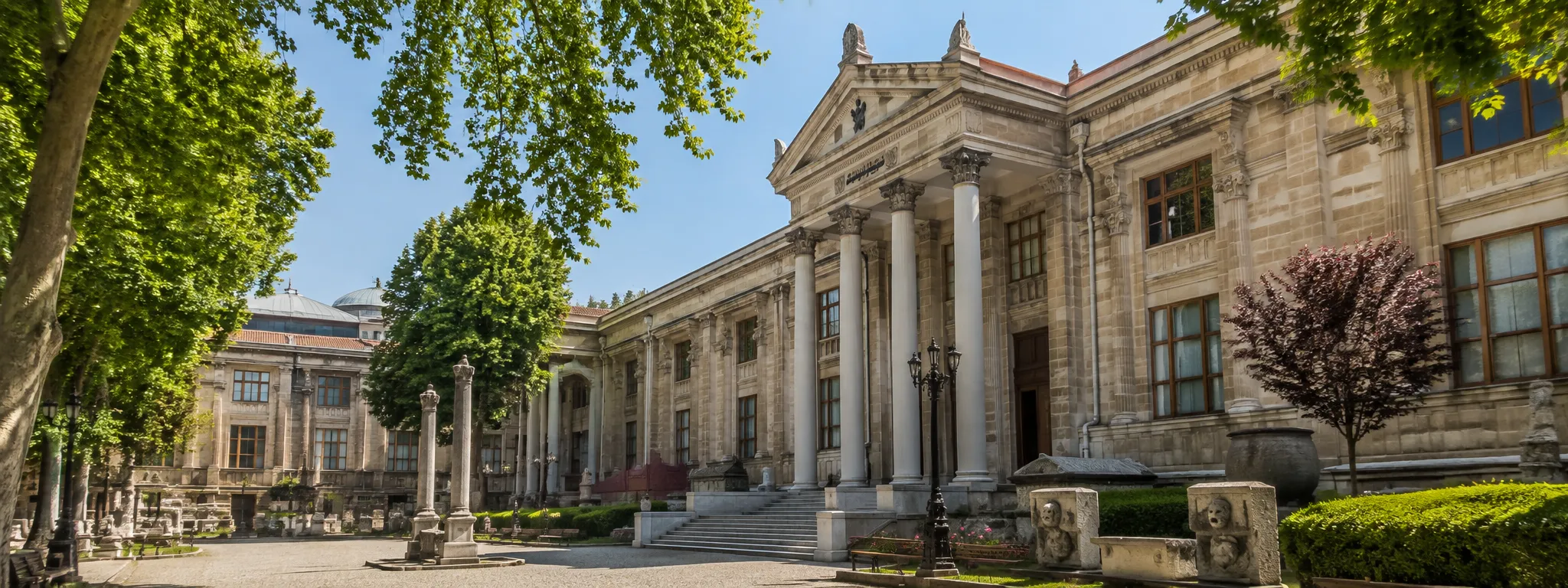
The Istanbul Archaeology Museums are easy to underestimate because they sit beside Topkapı Palace and Hagia Sophia, two attractions that dominate most first-time itineraries. Yet this is one of Istanbul’s genuinely world-class collections: nearly a million objects spanning Anatolia, the ancient Mediterranean, Mesopotamia, Egypt and the wider territories once governed from the city.
It is also a museum about museums. The complex grew from the Ottoman Imperial Museum, founded in 1869, and from the work of painter, archaeologist and museum director Osman Hamdi Bey. Its three principal buildings — the Archaeological Museum, Museum of the Ancient Orient and Tiled Kiosk — tell different parts of that institutional story. Restoration and conservation work can close individual rooms, so plan around what is open now rather than an old “must-see” checklist.
Is it worth visiting?
Yes, particularly if you enjoy ancient history, sculpture, archaeology or objects that connect Istanbul to a much wider geography. The museum adds context that the city’s Byzantine churches and Ottoman palaces cannot provide on their own. It is less suitable as a rushed filler between Hagia Sophia and Topkapı: the strongest rooms reward slow looking, and the sloping site plus several separate buildings make a five-minute dash unrealistic.
Understand the three-museum complex first
- Archaeological Museum: the main neoclassical building, opened in 1891 and designed to house major finds including the Sidon sarcophagi.
- Museum of the Ancient Orient: originally built in 1883 as the Academy of Fine Arts, now associated with collections from Mesopotamia, Egypt, Anatolia and neighbouring ancient cultures.
- Tiled Kiosk: built in 1472 under Mehmed II, the oldest structure in the complex and an important surviving example of early Ottoman civil architecture.
Your ticket and route may cover all three, but open galleries can change. Check the current official notice before assuming every floor or building will be accessible.
The Alexander Sarcophagus is not Alexander’s tomb
The museum’s most famous object was excavated at the royal necropolis of Sidon by Osman Hamdi Bey’s expedition in 1887–88. Its name comes from reliefs that include a figure identified with Alexander the Great; it was not Alexander’s coffin. Walk around it slowly. The battle and hunting scenes are exceptionally deep and animated, and surviving traces of pigment are a reminder that ancient sculpture was often coloured rather than bare white stone.
Do not rush past the other Sidon sarcophagi
The Alexander Sarcophagus belongs to a much richer group of elite funerary monuments. The Mourning Women, Lycian and Tabnit sarcophagi reveal different sculptural traditions, political identities and ideas about death. Seeing them together is more useful than treating the headline object as an isolated masterpiece. Look at faces, clothing, architectural forms and the ways Greek, Persian, Phoenician and local influences overlap.
Choose a route instead of trying to see everything
The collection can become tiring if you move case by case without a plan. I would choose one of three routes:
- 90-minute highlights: Sidon sarcophagi, one strong classical sculpture section and whichever of the Ancient Orient or Tiled Kiosk galleries is currently open.
- Two-to-three-hour first visit: add inscriptions, architectural fragments, ceramics and time to understand the buildings themselves.
- Specialist visit: focus on one civilisation, material or archaeological region and accept that you will leave large sections for another day.
What the Museum of the Ancient Orient adds
This part of the complex expands the story beyond Greece and Rome. Its collections connect Istanbul with Mesopotamian, Egyptian, Anatolian and other Near Eastern cultures. That broader frame is important: the Ottoman museum did not collect only the archaeology of the modern city or modern Türkiye, but material from across a vast imperial geography. If ancient writing, early states or cross-cultural exchange interest you, give this building deliberate time rather than treating it as an annex.
The Tiled Kiosk is an exhibit in its own right
The Tiled Kiosk predates the main museum by more than four centuries. Its architecture, tile decoration and long history as an exhibition space make it more than a container for ceramics. Even on a selective visit, pause outside to read the building before entering. It changes the experience from “one large museum” into a walk through several eras of Istanbul architecture.
Current opening and gallery closures
Checked on 30 September 2026, the official Ministry listing showed the complex open daily from 09:00 to 18:45. It also warned that several numbered ground-floor galleries, all upper-floor rooms in the main building and two ground-floor galleries in the extension were closed to visitors. Those details can change with restoration, exhibitions and seasonal programmes. Recheck the official Istanbul Archaeology Museums page on the day you visit rather than relying on an undated search result.
Tickets, MuseumPass and night opening
Ticket prices and pass terms are volatile. The official Ministry sales pages currently list the museum for e-ticket purchase and include it in MuseumPass Istanbul, but eligibility and final admission times differ between products. Summer night-museum access has also operated as a dated programme, not a permanent promise. Use the official museum and ticket pages for the exact product, last-entry time and evening schedule you intend to use; do not buy from a reseller merely because its search advert appears first.
Getting there without adding stress
The entrance is on Osman Hamdi Bey Yokuşu, between Gülhane Park and the Topkapı Palace area. Gülhane on the T1 tram is the most convenient stop for many visitors. From Sultanahmet you can walk, but expect historic paving, crowds and a slope. From the Asian side, ferries to Eminönü followed by the tram or a walk through Gülhane can be more pleasant than a road transfer.
Accessibility needs advance checking
This is a multi-building historic complex on sloping ground, and restoration can alter the available route. “The museum is open” does not prove that a specific floor, lift or gallery is step-free. If mobility is limited, contact the museum before visiting and ask which entrance, lifts, toilets and buildings are operating. Allow extra time between structures and avoid combining the visit with an already exhausting palace itinerary.
A better visit with children
Turn the museum into a short visual hunt instead of a comprehensive lecture. Ask children to find a lion, an ancient inscription, the most dramatic sarcophagus, a coloured detail and a tile pattern. Choose three or four memorable objects, then stop for Gülhane Park. A focused hour with a story is usually more successful than marching through every available room.
Photography and museum etiquette
Follow the sign at each gallery or temporary exhibition. Flash, tripods or photography may be restricted around sensitive objects even when ordinary handheld photography is allowed elsewhere. Keep bags clear of cases, speak quietly and never touch stonework or display surfaces. Temporary exhibitions can have different rules from permanent galleries.
Combine with Topkapı only if you pace the day
The museum is geographically ideal with Topkapı Palace, but both can absorb several hours. A sensible combination is Topkapı near opening, lunch, then a selective archaeology-museum route. If either Ottoman court history or archaeology is a primary interest, separate them. Adding Hagia Sophia and the Blue Mosque to the same day creates an impressive list and a poor experience.
Use Gülhane Park as the reset button
After galleries, Gülhane Park is the natural place to sit, walk and give your eyes a break before returning to the old city. It also makes the museum practical on mixed-interest trips: one person can spend longer with the collection while another takes a calmer park break nearby.
Official sources checked
For live access, opening hours, closures and ticket routing, use the Republic of Türkiye Ministry museum listing and its current gallery-closure notice. The Ministry’s Kültür Portalı overview is useful for collection and building history, but the live museum listing should decide your timetable.
Cheers, Carpe Diem & give the sarcophagi more than a fly-by! 🍻⏳🏺
TATS Man
Your old-city museum mate
