
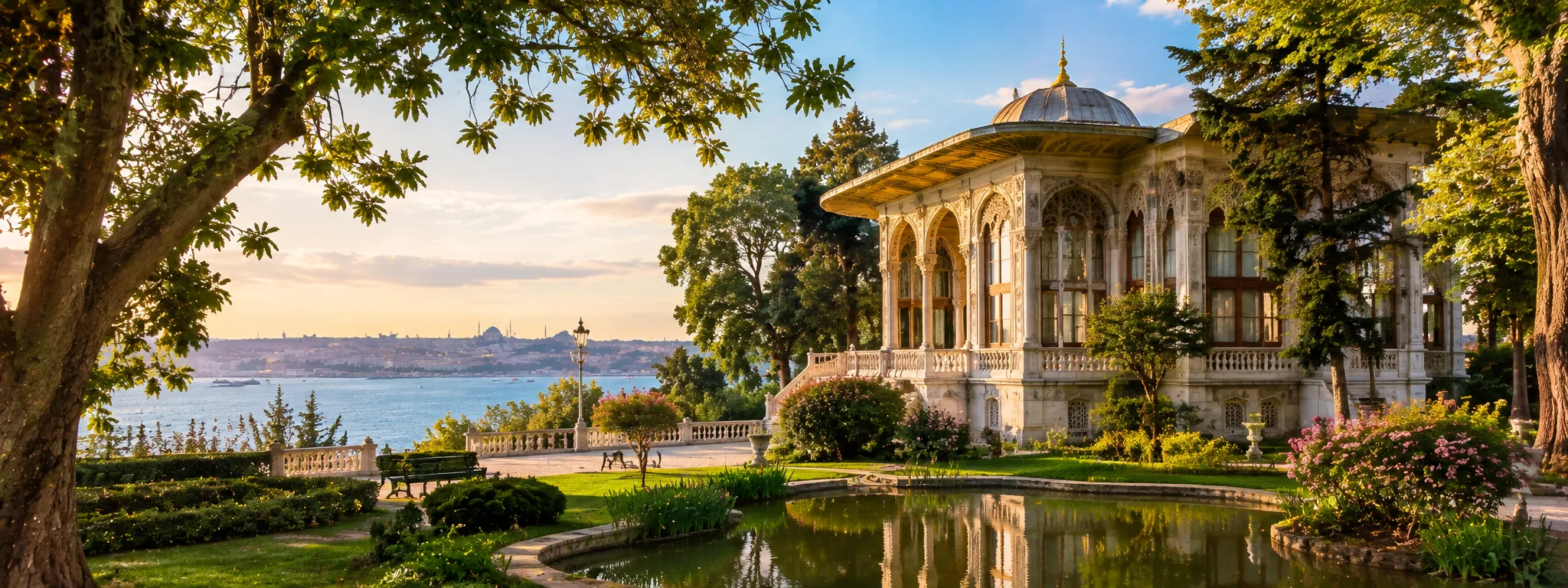
Yıldız is one of Istanbul’s strongest combinations of late Ottoman history and genuine breathing space. The palace complex rises above Beşiktaş on the European side, while the former imperial outer garden survives as Yıldız Park. They belong to the same historical landscape but work as two different visitor experiences: the palace is a ticketed museum complex with fixed opening rules, while the park is the flexible part of the visit.
Why Yıldız Palace matters
Yıldız Palace became the main residence and administrative centre of Sultan Abdülhamid II and is described by Türkiye’s National Palaces administration as the final administrative centre of the Ottoman Empire and the last residence of the sultan. Unlike Topkapı, which reads as an older imperial court, or Dolmabahçe, which presents a grand nineteenth-century ceremonial waterfront palace, Yıldız is a dispersed hillside complex of pavilions, administrative buildings, private spaces and gardens.
That difference is the reason to come. The site helps explain the final decades of the empire through the places where Abdülhamid II lived, worked and governed, rather than through one monumental façade.
Current visiting information
As of October 2026, the official National Palaces listing says Yıldız Palace is closed on Wednesdays. Ticket offices open at 09:00 and close at 17:00. The official listing currently shows a 900 TL foreign-visitor ticket, while domestic and reduced prices differ. Museum-card coverage also has exceptions within the Yıldız complex.
These details can change, especially around public and religious holidays. Check the current National Palaces page immediately before travelling rather than relying on an old blog or a screenshot of a previous price.
What you actually see
Yıldız is not one giant palace interior. The visitor experience is spread through a landscaped complex. National Palaces identifies major spaces including the Büyük Mabeyn and Küçük Mabeyn pavilions, Çit Pavilion, the imperial conservatory, Sultan Abdülhamid II’s library, Harem areas, the Has Bahçe and museum displays connected with the sultan and the Yıldız collections.
The broad layout matters. Leave enough time to move between buildings and gardens rather than judging the visit by how quickly you can finish one interior. The complex rewards people who enjoy political history, architecture, photography and the relationship between buildings and landscape.
Yıldız Park is a different experience
Yıldız Park occupies the former outer-garden zone of the palace estate. It is wooded, hilly and much less formal than the palace museum route. Mature trees, winding paths and the slope above the Bosphorus make it a useful counterweight to dense sightseeing around Sultanahmet or the busy Beşiktaş waterfront.
Do not assume “park” means flat or effortless. The gradients are real, paths can be tiring in hot weather, and the most pleasant route depends on which gate you use. Comfortable shoes matter more here than a tightly timed sightseeing plan.
Palace first or park first?
If the palace is a priority, visit it first. Fixed museum and ticket-office hours give you less flexibility, while the park can absorb delays later in the day. This is especially sensible in summer when the exposed uphill walking is easier earlier.
If greenery is your main goal and the palace is optional, reverse the order: use the park as your core visit and decide on the museum only if time, energy and opening hours still work.
How long should you allow?
Palace only: around two hours is a sensible minimum for a purposeful visit.
Palace + park: allow roughly three to four hours, especially if you want coffee, photography or a relaxed walk.
Half day: the better choice if you are combining Yıldız with Beşiktaş, Ortaköy or Dolmabahçe and do not want the day to become a race.
Getting there
Yıldız sits uphill from central Beşiktaş. Public transport can get you into the Beşiktaş/Yıldız area, but the final approach often involves gradient and walking. The site is geographically close to Dolmabahçe Palace and the Beşiktaş waterfront, but “close on the map” does not mean level or effortless on foot.
If mobility is limited, summer heat is strong or you are travelling with young children, consider using a taxi or bus for the uphill section and walking downhill later. Build in more time than the raw distance suggests.
Best combinations nearby
Yıldız + Dolmabahçe
A strong history-heavy pairing. Visit Dolmabahçe Palace earlier, have lunch around Beşiktaş, then move uphill to Yıldız. Check both museums’ current closing days before fixing the date.
Yıldız + Beşiktaş + Ortaköy
This creates a more varied day: palace history, green space, local Beşiktaş streets and then the Bosphorus waterfront around Beşiktaş–Ortaköy. It is a better geographical fit than trying to add Sultanahmet as well.
Yıldız + Çırağan waterfront
If you mainly want a walk, descend toward the Bosphorus after the park and continue along the waterfront. This lets the hill work in your favour instead of ending the day with a long climb.
Who will enjoy Yıldız most?
Yıldız is especially rewarding for repeat Istanbul visitors, Ottoman-history enthusiasts and travellers who have already seen Topkapı or Dolmabahçe and want a different chapter of palace history. It also works well for families or mixed-interest groups because the day does not have to be entirely indoors.
If your priority is one instantly recognisable ceremonial palace interior, Dolmabahçe may be the more obvious first choice. Yıldız is stronger for context, landscape and the late-imperial story.
Accessibility and comfort
The combination of a large site, hills and outdoor paths makes Yıldız more physically demanding than a simple indoor museum visit. Surface quality and gradients vary. Visitors with mobility limitations should check current access arrangements directly with National Palaces and plan transport between the lower Beşiktaş area and the palace entrance rather than assuming every route is step-free.
Bring water in warm weather, allow shade breaks, and avoid stacking Yıldız after an already exhausting morning of steep walking elsewhere in the city.
Common mistakes
- Turning up on Wednesday without checking the closure.
- Using old ticket prices from before later reopening phases.
- Assuming Yıldız Park and Yıldız Palace are one free attraction.
- Underestimating the size of the complex and the uphill walking.
- Trying to combine Yıldız, Dolmabahçe and Sultanahmet in one rushed half day.
- Planning around a specific pavilion or section without checking whether that area is currently open.
Practical verdict
Yıldız deserves more than a quick detour if late Ottoman history interests you. Treat the palace as the fixed-time anchor and the park as the flexible half of the visit. Arrive with enough time to understand the complex as a landscape rather than a single building, then finish downhill in Beşiktaş or along the Bosphorus. That rhythm makes far more sense than squeezing Yıldız between two distant timed attractions.
